Our mission is to prove the feasibility of compact regional air mobility by building and designing a one-seater Albatross aircraft.
We believe in a future where autonomous aircraft offer a more sustainable and efficient way of door-to-door travel.
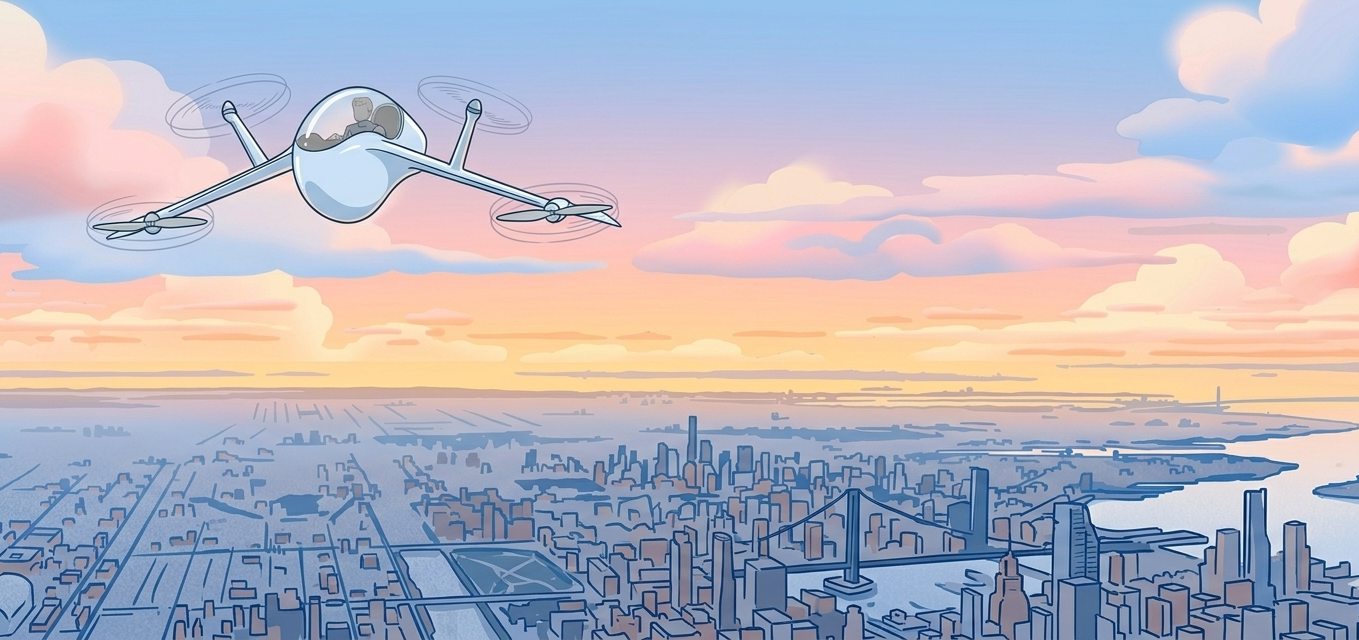
Imagine stepping out the front door, getting into an aircraft, and taking off from a parking space. From your doorstep to the skies within minutes. You can simply sit back and relax as the autonomous systems guide you from door to door. The only vehicles currently capable of this are electric multirotor aircraft with limited range. Albatross aircraft solve this problem by incorporating a long, efficient wing. Due to a swept wing design and thrust vectoring engines, no tail is needed. This results in a rectangular footprint, ideal for parking.
The blended wing body design also gives Albatross craft excellent aerodynamic efficiency. With current-day battery technology this results in a range of 175km, which only gets better as battery technology improves.
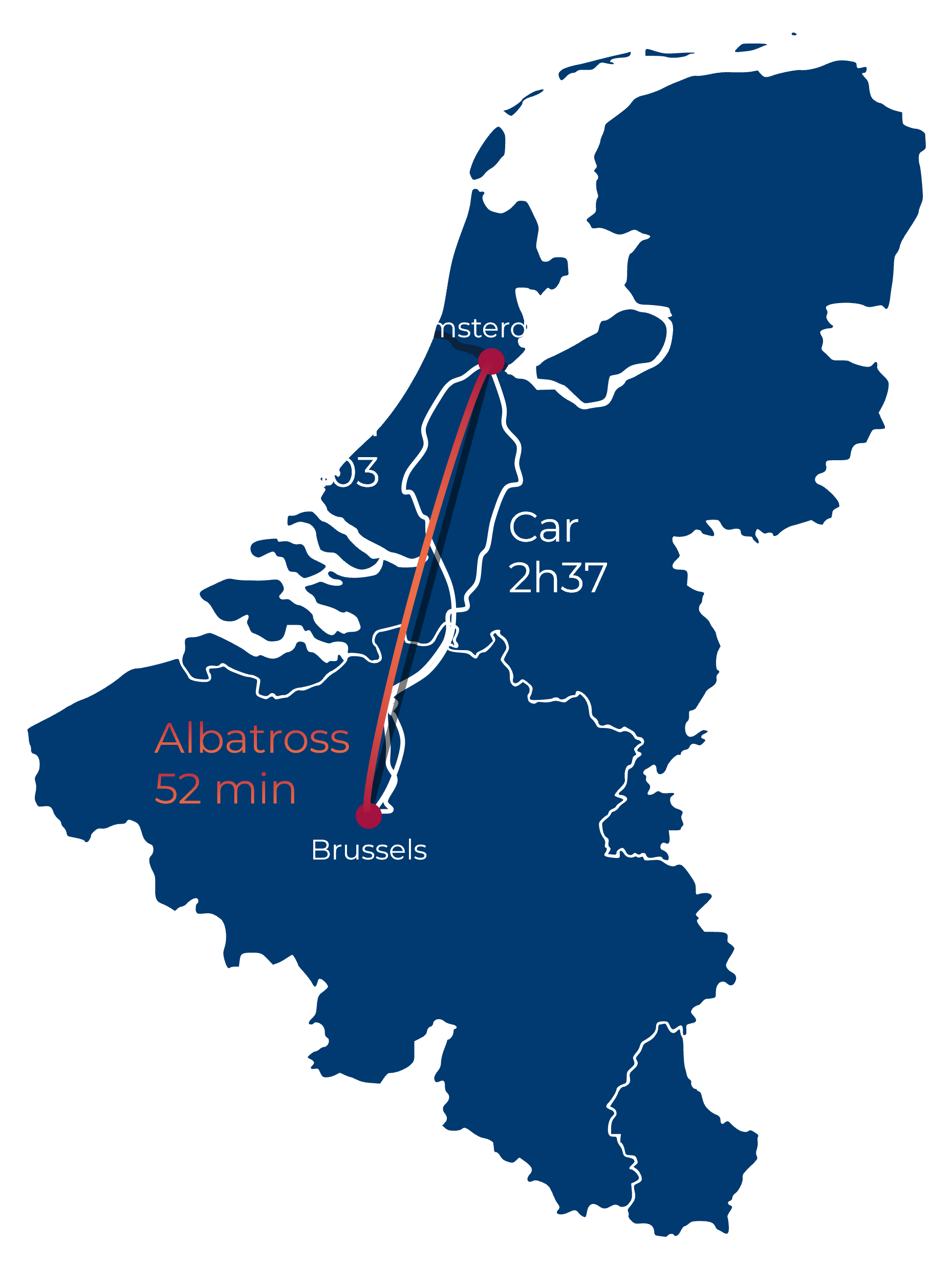
With this range, Albatross is suitable for regional commutes and serves as a great alternative to cars. With a cruise speed of 230km/hr, flying by Albatross more than halves even the most favourable travel times.
Furthermore, travel by Albatross doesn't rely on roads, saving even more time when traffic is bad or where terrain is rough. Not to mention that these road networks take up vast amounts of space, disrupt local ecosystems, and are expensive and time consuming to build. With Albatross only needing a parking space and the skies to travel it is clearly the more sustainable choice.
Another advantage of air travel over road travel is autonomy. Due to the predictability of the airspace, this is easier to implement in aircraft than in cars. The only catch here is that autonomous flight is currently not yet permitted. However, with sufficient innovation and demonstration of the technology these regulations can be changed.
Air travel is already a lot safer than other means of transportation, but autonomy could take this even further by eliminating human errors. Furthermore, the design has extensive safety features. It is still capable of hovering even when one engine becomes inoperative. In a worst case scenario, a ballistic parachute can be activated to protect both those in the air and on the ground.